One of the first platforms for A/B testing SEO metadata.
Co-founded with an SEO specialist and a designer. I led the technical build. The platform ran sequential A/B tests on a page’s title and meta description, measured the lift in click-through from the search results, then shipped the winners. As far as we could find, nobody had built it before.
- SEO A/B testing
- First-mover
- Two years
- 2020–22
- Integrated
- 3 platforms
- + UK & US agencies
- Greenpeace
In one paragraph.
Polkadot Tiger was a B2B SaaS platform for A/B testing SEO metadata. My co-founder, an SEO specialist, had spotted that metadata barely moves rankings on its own but it decides the snippet you show in the search results, the single biggest lever on whether someone clicks. We built a way to test that properly: run a control period, rotate variants of a page’s title and description, and measure what actually moved.
I led the technical side: the architecture, the data pipeline, the platform itself. I co-founded it with two friends, an SEO specialist and a designer. It’s the project I’m proudest of, a genuine 0→1, conceiving an approach to SEO testing that, as far as we could tell, had never been built.
What makes it different.
Metadata is a click lever, not a ranking trick
Metadata barely moves rankings on its own, but it controls your snippet in the search results, and a sharper snippet wins clicks from a position you already hold. For a page sitting at #5 on a high-traffic term, lifting click-through a few points (or nudging #5 to #4) can mean serious revenue. Get the copy right and you set the right expectation too, so people convert once they land, which feeds back as a positive signal to the search engines.
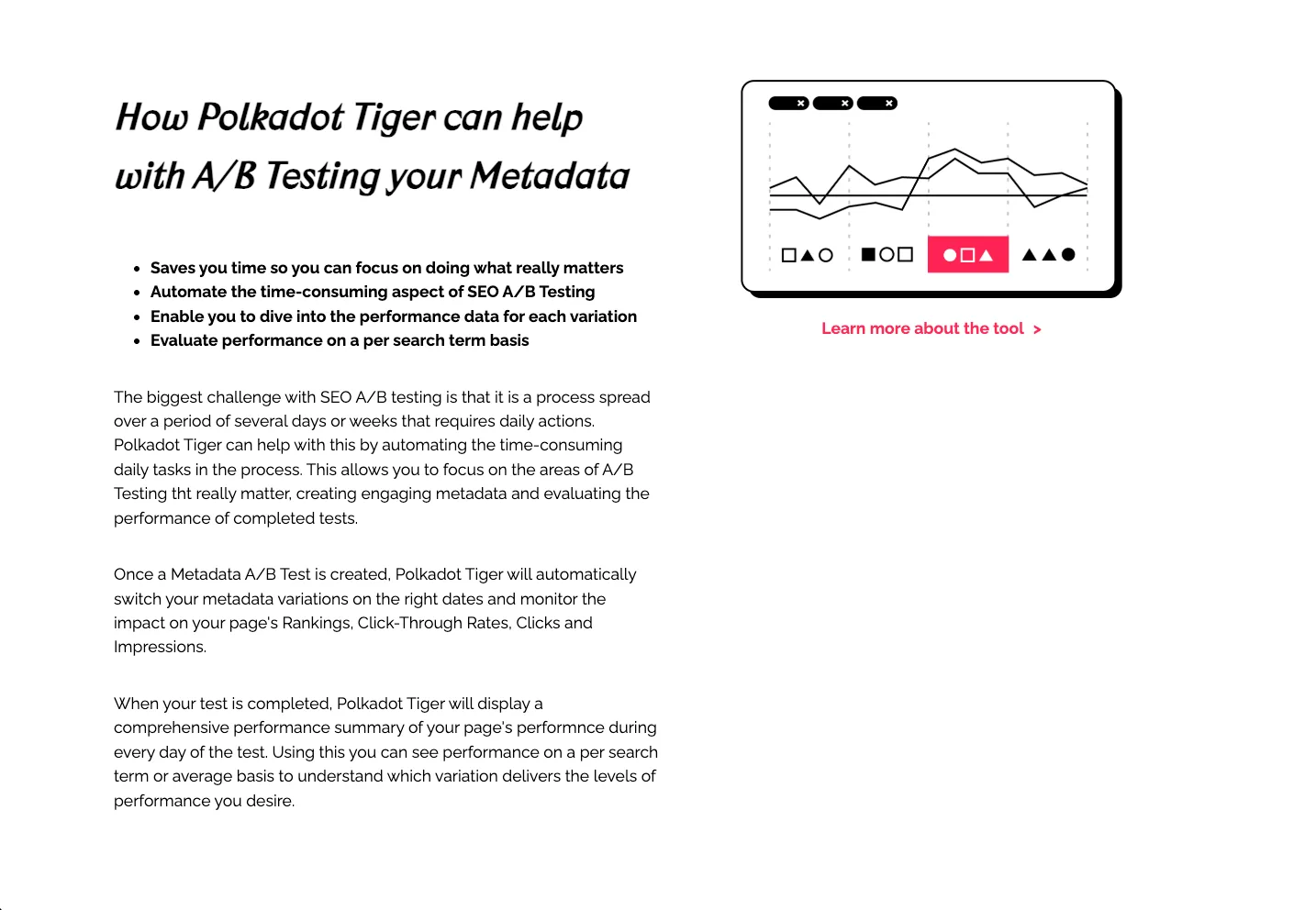
Sequential tests on live metadata, measured properly
Set it running and leave it. The platform pulls a control baseline from Google Search Console, then rotates each variant onto the live page for a set window (three weeks, say), tracking click-through and ranking daily, and conversions through analytics. When one variant ends it swaps in the next, charts the lot over time, and emails you when a test starts or finishes. Statistical rigour where SEO usually ran on gut feel.
The features that matter.
Variant builder
Set a control plus as many metadata variants as you like (title and description per page) and queue them for the test.
CMS integrations
Connected straight into WordPress, Magento and Shopify to read current metadata and write each variant onto the live page automatically.
Search Console + analytics
Pulled ranking and click-through from Google Search Console and conversions from Google Analytics, so every variant was judged on traffic and revenue.
Hands-off scheduling & charts
Schedule tests in advance. The platform runs them unattended, charts each variant daily, and emails you when one goes live or a test completes.
How it's built, and the system around it.
A React front end on a Laravel back end. The UI was the easy part. The hard part was trusting the numbers: SEO data is noisy and arrives from several sources, and a chart that’s subtly wrong is worse than no chart, so the data layer earned the most attention.
Search Console gave rankings and click-through. Analytics gave conversions and the gated, on-site metrics that told us whether a variant set people up to act once they landed. The platform stitched those together per variant, per day, into the charts. I leaned on test-driven development to keep the metrics honest, validating the aggregation and statistics so the visualisations could be trusted.
- React Front end · dashboard
- Laravel Back end · API
- Google Search Console Rankings · click-through
- Google Analytics Conversions · on-site metrics
- CMS connectors WordPress · Magento · Shopify
The motivation.
By 2020, SEO was the last big corner of digital marketing still running on gut feel. Everyone A/B-tested their checkout; nobody A/B-tested the snippet that won the click in the first place. My co-founder had the insight that you could, and should, test metadata directly. I wanted to find out whether it could be built, and built so it ran itself: set a test and walk away. The bet wasn’t wrong. The timing was early.
What I learned
We were early, possibly first, and that cut both ways. Merging two fields, A/B testing and SEO, created a category that didn’t exist yet, so every sale started with educating the market. Agencies liked it but couldn’t easily sell it on to clients who’d never heard of the idea. As a bootstrapped team with no funding, that sales cycle was brutal on both acquisition and revenue. We signed leading agencies in the UK and US and worked with Greenpeace and other charities, but couldn’t reach profitability, and after two years we parked it.
The clearest lesson: the technique is most valuable to very large sites, where a few points of click-through is real money, and breaking into that tier without funding or contacts is its own hard problem. Big sites also tend to run bespoke stacks, so our off-the-shelf integrations were a poor fit. If I ran it again I’d bring in a partner with those relationships, or find a niche where smaller brands get enough value to become the growth engine themselves.
It’s the project that turned me into a product manager. Conceiving the approach was the fun part; learning that a great build with no market is still no business was the expensive part. Most of what I’ve done in product since traces back to it.
Selected views.